
As Islamic assets see continued growth, does that pose a concentration problem?
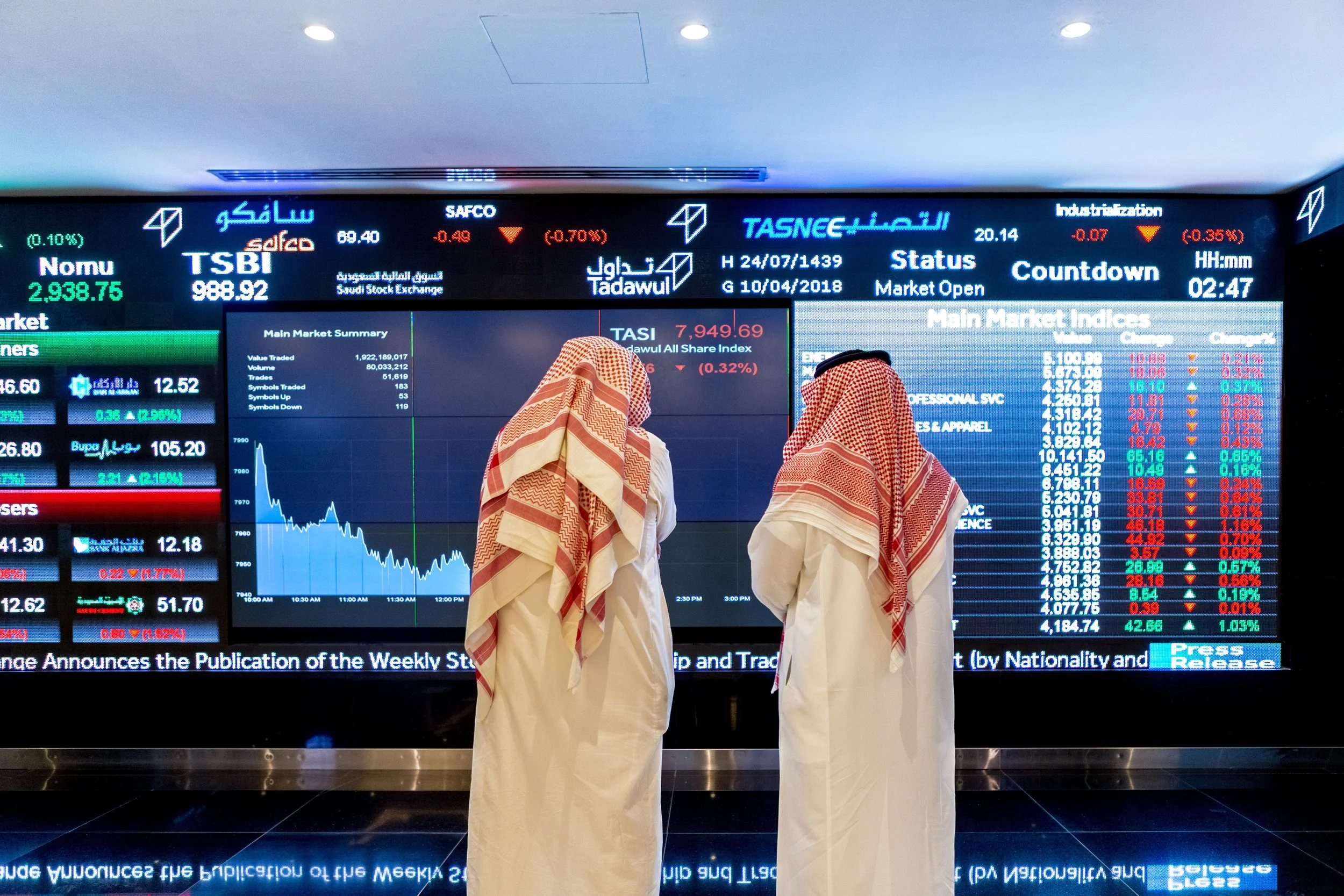
The Islamic finance market has grown by nearly 200 per cent in recent years, with growth in bond-like instruments now making it possible for pensions to provide more diversified options. But does that pose a concentration conundrum? (Abdulrahman Abdullah/Bloomberg)
Currently commanding $5.9tn in assets globally, the Islamic finance universe has grown by nearly 200 per cent over the decade between 2014 and 2024.
Market research firm Mordor Intelligence claims it has a projected annual growth rate of 10.7 per cent over the next five years to reach $8.5tn by 2031.
This market is generally agreed to have been established with the founding of Dubai Islamic Bank in 1975 - the world’s first commercial Islamic bank.
The market’s growth is attributed towards rising wealth in Islamic countries, supported by high oil prices, and to conventional banks entering the scene - among other reasons.
It remains dominated by Islamic banks and geographically centred around the Gulf Cooperation Council. But now international investors, including pension schemes, are beginning to sit up and take note.
“I think it’s a big opportunity that is about to take off,” Mohieddine Kronfol, head of MENA fixed income/global sukuk at Franklin Templeton, told AOX. “Particularly in western pension systems.”
Islamic investing is constrained by sharia law which includes rules against involvement in unethical businesses like gambling, tobacco, pornography, conventional banks and insurance firms and alcoholic manufacturers, and the distribution of interest (riba).
Most pension schemes have so far limited their sharia-compliant investment options to equity-only portfolios, usually offered as a self-selection product to members.
But UK master trusts have begun offering more diversified options. Standard Life, L&G and Smart Pension have all recently launched sharia-compliant pension products with a glidepath from higher-risk to lower-risk investments throughout retirement, just like a traditional default lifestyle. Natwest Cushon (which the bank is currently selling to WTW) is planning to follow suit, according to head of investment proposition Kinna Patel.
This shift has been made possible in large part through the introduction over the past 10 years of sukuk instruments, also known as Islamic bonds. Unlike traditional bonds, these represent partial ownership in real assets and offer fixed income characteristics without contravening sharia law against riba.
The sukuk market has grown at a combined annual growth rate of around 20 per cent since 2020 to reach a total value of $1.1tn in 2025, Franklin Templeton reports.
Sukuk issuance has gone up by 40 per cent since 2020, according to the World Bank, with particular growth in green sukuks markets where issuance is up more than 200 per cent.
For pension schemes, it has enabled the development of sharia-compliant multi-asset and fixed income funds, which are used to build those retirement glidepaths.
Kronfol added: “The technology exists to have private equity and private credit [vehicles]” too, meaning even more diversified sharia-compliant portfolios will become possible.
But Islamic assets including sukuk are inherently concentrated in countries where Islamic institutions are located. State Street Global Advisors found GCC countries accounted for 56 per cent of global sukuk issuance in 2024. Once East Asia is included this accounts for more than 75 per cent of all Islamic assets.
When there is regional upheaval, like the US and Israel’s war with Iran, the concentration alarm bells can start ringing.
Similarly, sharia-compliant equity funds tend to be highly concentrated in tech stocks - especially North American ones - because of sector exclusions. While this very concentration has led sharia portfolios to outperform many of their peers in recent years, rumblings of a possible tech or AI bubble start to make this kind of portfolio look less appealing.
The antidote to concentration is of course diversification, and the good news is that the Islamic asset market is trending that way.
Earlier this year the government of Benin made its debut sukuk issuance. It joins countries including Egypt, Luxembourg, the UK, Hong Kong, Singapore, South Africa and Turkey, with most new market entries having taken place in the last five to seven years, according to Kronfol. Morocco plans to follow their lead in the next year.
Kronfol said Islamic assets aren’t easily derailed by regional upheaval. He said: “Even with its concentrations, the sukuk market has been extremely resilient over the past 10 years. It has exhibited very defensive characteristics and had smaller drawdowns and less volatility than other markets.”
The GCC is a rapidly developing market with a strong programme of economic diversification. While the current conflict has put the brakes on, with the S&P GCC Sukuk Index falling by 2 per cent since the start of the war in Iran, Kronfol expects growth to pick back up afterwards. He predicts the global sukuk market could be worth $2.5tn by 2030.
Of course investors in the Islamic market will want to protect their portfolios.
“Bankers will probably now make a bigger effort to try to bring in different risk factors, different countries, different companies, because they know that the demand would be available,” Kronfol said.
“[But] equally I don’t think the market for the incumbents is going to dry up either.”