
European stocks poised for growth but US rhetoric over Greenland dents optimism
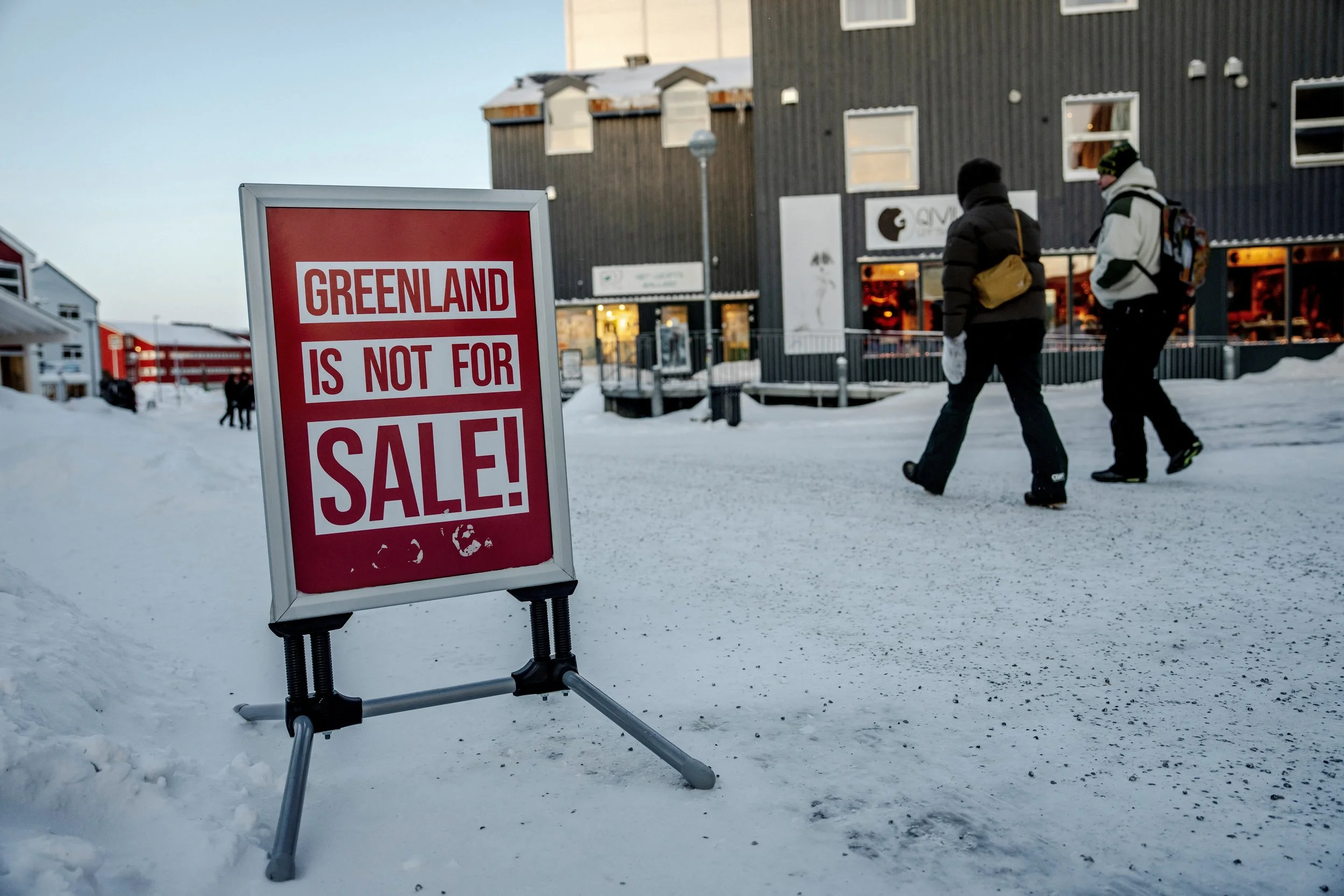
European equities have been unsettled by escalating tensions between the US and several European countries over Greenland but there are other issues which dent optimism, including the lack of innovative tech businesses (Ritzau Scanpix/Mads Claus Rasmussen via Reuters)
European equities outperformed the US in aggregate last year, prompting cautious optimism among forecasters for growth in 2026. But that optimism has been dented by renewed US threats over Greenland, which have unsettled markets and raised the risk of fresh trade tensions with Europe. In addition, persistent volatility and a thin pipeline of innovative technology businesses risk limiting investor appetite as the AI transition accelerates.
2025 was a broadly positive year for European equities, with the MSCI Europe ex-UK Index returning 20.4 per cent in euro terms, amid what Mislav Matejka, head of European and international equity strategy at JPMorgan, has called an improving "risk-reward outlook" for the Eurozone. For the full-year, Europe's returns outpaced returns on the S&P 500, which gained 17.9 per cent in dollar terms.
Yet data our sister title MandateWire shows European investors channeled only a net $684mn into European equities (excluding UK equities) last year, a steep decline from $3.3bn in 2024. Net inflows* had already been subdued, totalling $684mn in 2023 and $548mn in 2022.
In spite of recent optimism, the continent's stocks looked somewhat lacklustre against gains of the 10 largest US stocks, mainly dominated by AI-aligned tech companies, which accounted for 53 per cent of total returns on the S&P 500 in 2025, according to Goldman Sachs.
Fresh tensions over Greenland
Aside from the US surge in AI-aligned stock values, European equities have been unsettled in recent days by escalating tensions between the US and several European countries over Greenland, the world's largest island, which has been part of the Kingdom of Denmark for more than 300 years.
On January 17, US President Donald Trump announced that several European countries including Germany, Norway, Denmark and the UK would be subject to a flat tariff rate of 10 per cent on imports to the US, coming in on February 1, rising to 25 per cent on June 1.
The announcement was made in response to the countries' collective refusal to entertain questions over a potential purchase of Greenland.
European equities fell sharply on Monday (January 19) as investors digested the news. However, commentators seem divided on what the fallout could mean for markets in the future.
John Wyn-Evans, head of market analysis at Rathbones, estimates a 10 per cent tariff rate could shave around 0.1 per cent off the GDPs of the continent's most tariff-exposed economies, namely Germany and the UK.
There could also be implications for European-owned US government debt, with US treasuries held in significant quantities by the UK ($888.5bn) in November 2025, Belgium ($481bn), France ($376.1bn) and Norway ($218.9bn), according to US Treasury data.
Kaspar Hense, senior portfolio manager at RBC BlueBay Asset Management, says escalating Greenland tensions mean it is "quite possible" EU investors will offload US government bonds. This could have knock-on impacts on the price of US debt.
"The dispute could put pressure on interest rates worldwide and also have an impact in the US," Hense says. "The US is dependent on foreign investors."
But Wyn-Evans predicts the "political ramifications" for Europe would be "greater" than the economic impact.
"Any attempt to coerce Denmark or force a transfer of Greenland would severely damage transatlantic relations and strain Nato," Wyn-Evans says.
Optimism for 2026?
European equities also suffered several bouts of volatility and underperformed against other regions in the middle of last year, Stephen Budge, a partner at LCP, explains to MandateWire Analysis.
Budge noticed some UK pension schemes moving into European equities early last year. But these ended up among the "bottom of the pile" in terms of portfolio performance at the end of Q2 and Q3 2025, as US stocks caught back up following tariff-related volatility.
This assessment was affirmed by Morningstar's Europe Equity Market Outlook for Q1 2026, which found that European equities had "been through the wringer in 2025, experiencing massive levels of volatility along the way".
Yet Matt Tickle, chief investment officer at Barnett Waddingham, tells MandateWire Analysis that Europe stocks are now generally "cheaper from an equities standpoint" than the US, and narrowed ahead of the US slightly in total year-end performance as US equities became more expensive.
But he says there is a question over whether investors "expect earnings to now come through within Europe to justify those higher valuations".
"Our view is, the jury is definitely still out on that", Tickle adds.
In spite of lower allocations to European equities tracked by MandateWire, geopolitical volatility and questions over earnings potential, some analysts have been positive on the region's potential for 2026.
JPMorgan's Matejka wrote in a November research note for the bank that he expected the European economy to "outperform its peers through the end of [last] year and beyond", in spite of some continuing investor weariness around the Russia-Ukraine war and France's political environment.
"Eurozone earnings for 2025 have seen persistent downgrades over the last year. But projections for next year are much higher, at nearly 15 per cent, on a combination of easy base effects, an improving macro backdrop, rising liquidity, a better China outlook and fiscal stimulus," Matejka said.
Matejka added that Europe's largest companies, often nicknamed the Granolas, which includes pharmaceutical heavyweights like GlaxoSmithKline, AstraZeneca, Novo Nordisk and Roche, and consumer giants like L'Oreal and Nestle, may have "gone stale" on the whole, amid a period of underperformance, but he foresees a better outlook for these given resilient company earnings and more cash-heavy balance sheets.
By contrast, Morningstar flagged in its Q4 equities outlook, released in early October, that more opportunities could instead come from small and mid-cap equities rather than Europe's largest companies, with the "discrepancy in valuation" between larger players and smaller enterprises "even more pronounced in Europe than in the US".
Away from the listed market, a significant proportion of investor opportunity could come through in the form of private equity investment. Some European investors interviewed by MandateWire in recent months are eager to use private capital as a means to target Europe's burgeoning green transition.
MandateWire reported in December that the Dutch single-family office Alphatron had made a commitment to SevenGen Investment Partners' climate-transition SevenGen Growth Fund, as part of a €65mn ($78mn) funding round, which would allocate funds to north-west European startups with a climate-positive bent. The Belgian family office Victrix also made a commitment.
At the time, Frederik Deutman, co-founder of SevenGen Investment Partners, said Europe had "world-class innovation in climate tech, but often loses out at the growth stage".
“It's very clear [Europe has] missed the bus on [AI innovation]. It is very much a US story when you look at the holdings”
Where are the AI champions?
However, an absence of AI champion businesses in Europe could weigh on the stock market in the long term, if gains are outpaced by continued stellar performances on the S&P 500.
Kenneth Lamont, a principal for manager research at Morningstar, tells MandateWire Analysis there are few fund options for European investors seeking exposure to AI outside the Magnificent Seven.
"If I was a fund provider, I would definitely be looking at that," he adds.
In spite of the fact that many of the AI investment funds are run by European managers, Lamont says that "the number of European AI champions is almost zero when it comes to the core AI exposures".
"It's very clear [Europe has] missed the bus on [AI innovation]. It is very much a US story when you look at the holdings," he adds.
Tickle adds that Europe has "limited exposure" to AI as a "megatrend". While the Dutch company ASML has proven an important part of the global semi-conductors supply chain, he says that "going towards Europe means you're missing out on" the future uplift from AI.
"We're certainly not convinced that moving from the US to Europe is a good return generator," he affirms, but adds that Barnett Waddingham is "having conversations" around whether moves away from the US are "still justified" from a risk-management perspective.
He asks rhetorically: "If you just buy the market, have you got too much exposure towards the top 10 US companies?"
*Net inflows comprise total inflows from mandate awards, plus total inflows from assets reweighted to the asset class, minus outflows from asset reweights and terminated mandates.